
Constructing a better attack
We Can Fix Them

Someone asked me this week about how we can improve our attack. Since Mark Wilson and Brian Graham took over, we’ve looked much more solid at the back, but we’ve looked less likely to run riot at the front too.
Under Kris Doolan this year, we scored 2 or more goals 8 times in 25 games (32%), and conceded 2 or more 8 times as well. Since Wilson and Graham took over, we’ve played 11 league games, and only conceded 2 or more goals twice (against Airdrie and Hamilton) - in fact, we’ve yet to concede more than 2 goals under them.
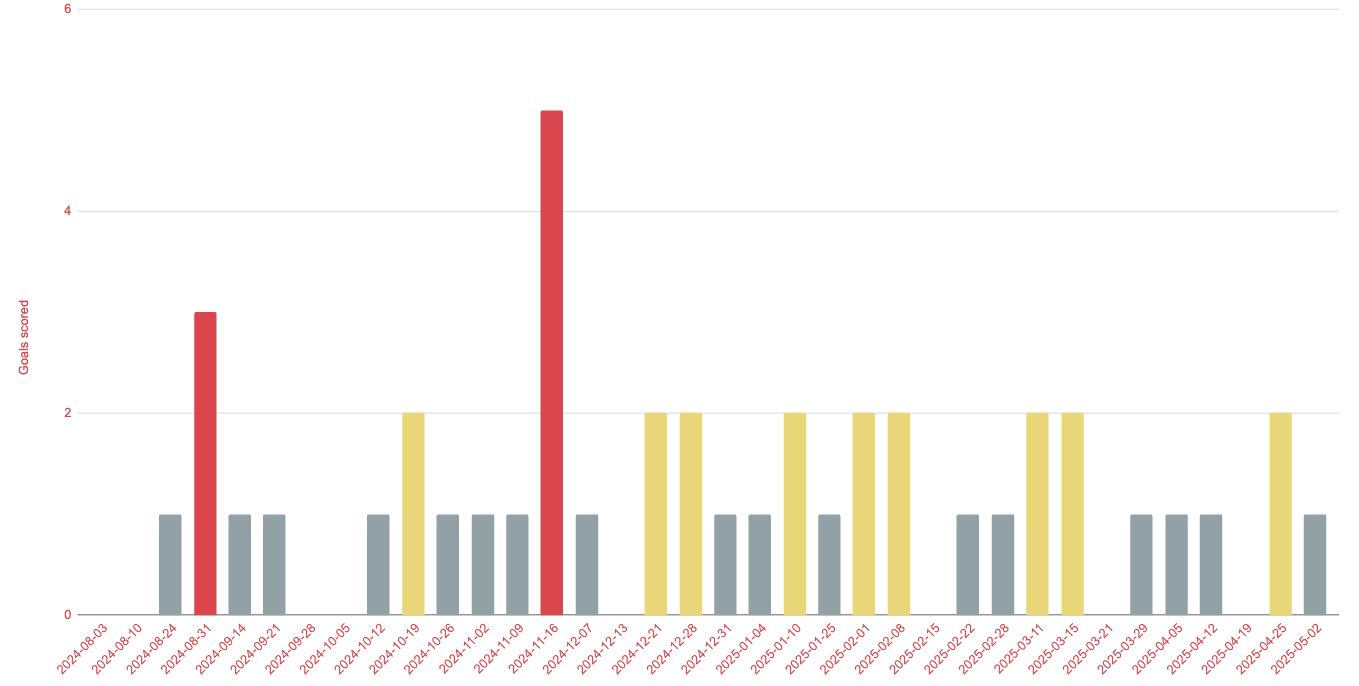
All season, we’ve only scored 3 or more goals twice - the last of them back in November against Hamilton. Under Doolan, we averaged 1.24 goals a game, and since Wilson and Graham took over, only 1.09. We’ve only scored 2 or more goals three times since they took over.
So how do we fix that? How do we generate more goals next year? That’s not going to be fixed tonight (especially not if the injury rumours are to be believed), but we need to begin planning for next season and being a more dangerous side.
Earlier in the year, I made a small contribution to an analysis undertaken by Tony Kinnear (who has worked for Thistle for over a decade), looking at what Falkirk do that makes them so good, and what Thistle could learn from that. He posted the report on LinkedIn last week in case you’re interested - I think it’s a really interesting piece of work.
Some of the ideas in that report are helpful for answering the main question: how do we get better in attack?
Let’s look at six Ps.
Progression
The first and most important factor we need to explore is ball progression. When I first looked at this, the single most correlated feature to how many points you rack up is how many progressive actions your team produces per game. Basically: how often you move the ball significantly and successfully towards your opponent’s goal with a single pass or run.
When it comes down to it, teams that have more progressive actions get more points.
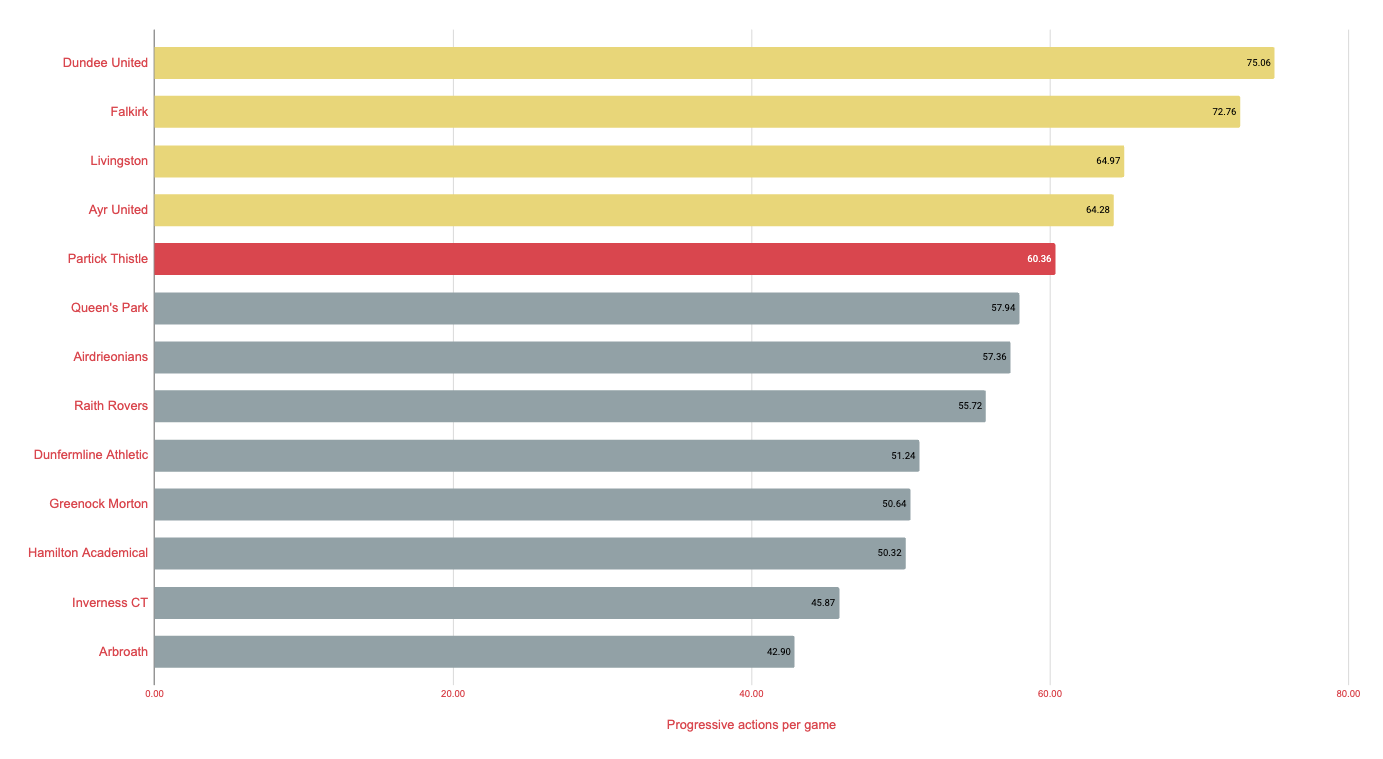
The two teams who progressed the ball most often in the last two seasons were … Dundee United and Falkirk (who both did it more than 70 times in an average game, not far short of once a minute and certainly more than once per minute on the ball). What else do those two teams have in common, I wonder? Progression makes prizes.
3 and 4 in the rankings are Livi and Ayr, who both do it around 65 times a game (less often than United and Falkirk, but still pretty often). Thistle clock in at 5th, only about 80% of the times that United and Falkirk do it. We’re good, But not elite.
The bottom of the table is equally telling - Hamilton, ICT and Arbroath (in the Championship) are the bottom three.
This is the single most important thing in having an effective attack - getting the ball forward - not just by hoofing it, but by moving the ball at least 30m (in your own half) or 10m (in the opposition half) towards the opponent’s goal in a single action (pass or run) and still retaining the ball. If you do that a lot, you score more goals and get more points.
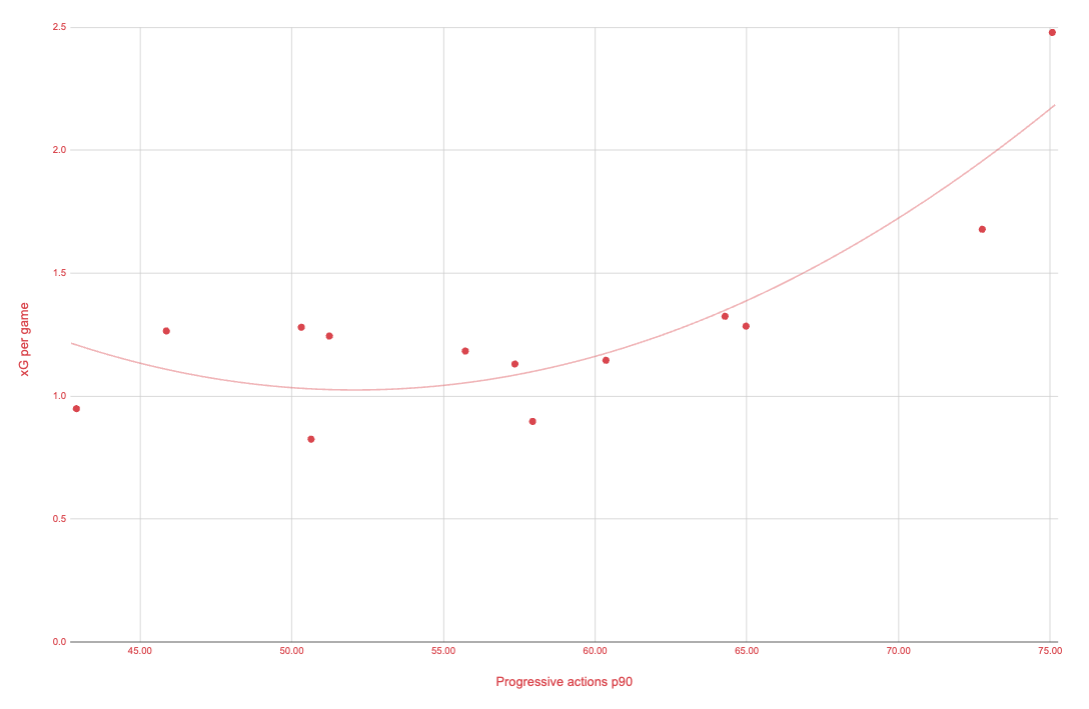
Thistle are good, but not elite.
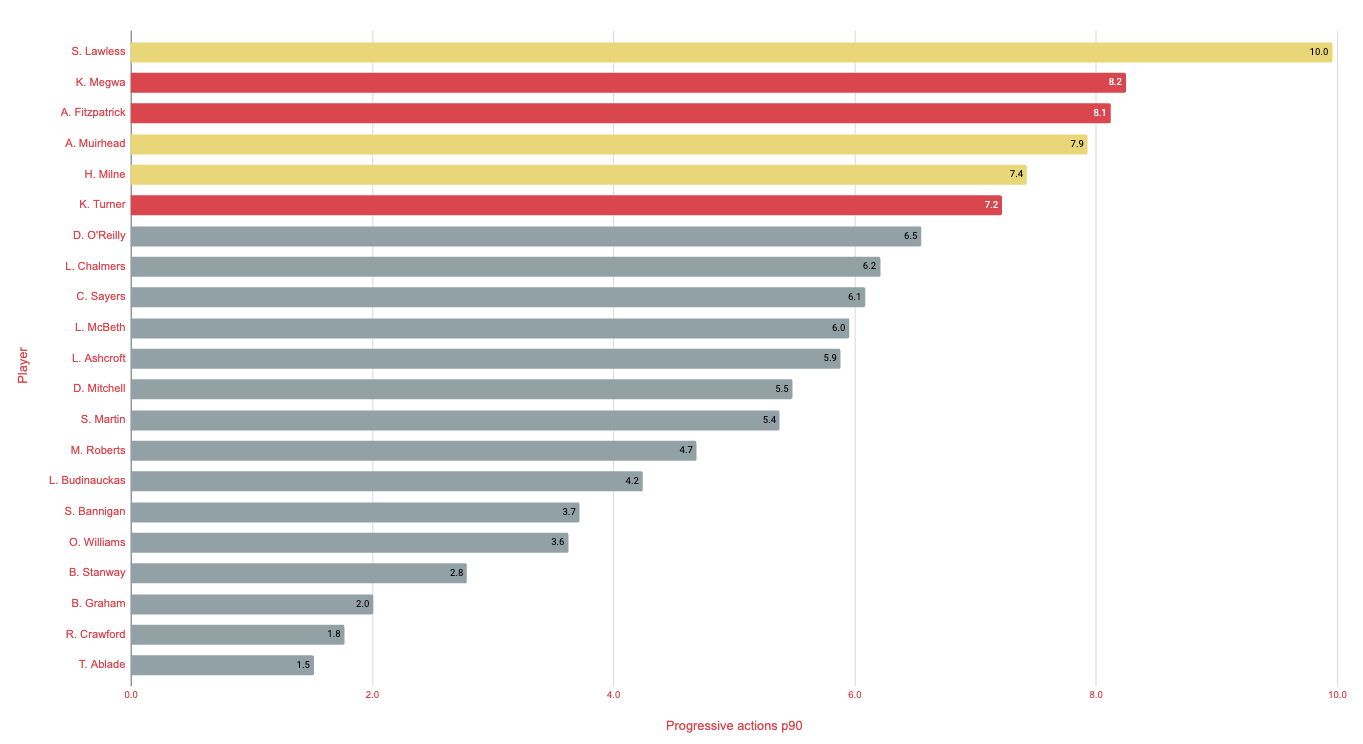
The picture gets worse if you look at who these progressive action moments come from. Stevie Lawless is a beast. When he’s fit and contributing, he gets 10 progressive actions per game. On his own, he’s enough to lift us from the ‘low playoff’ attacking unit to ‘not far from champions.’
And he’s not been fit for much of the last two years. We’re missing his 10 progressive actions, and mostly playing players who only contribute about half that.
Of the top six individual contributors, two of the others are dear departed Harry Milne and King of Arbroath Aero Muirhead. Other than Megwa, Fitzy and Turner, there’s no other player in our team who contributes above 7 a game.
So: major order of business if we want to challenge for the title next year and lift our attack is to recruit players who generate these progressive actions.
Penetration
The next aspect is an evolution of ball progression. We need to get better at making dangerous passes close to the opposition's goal.
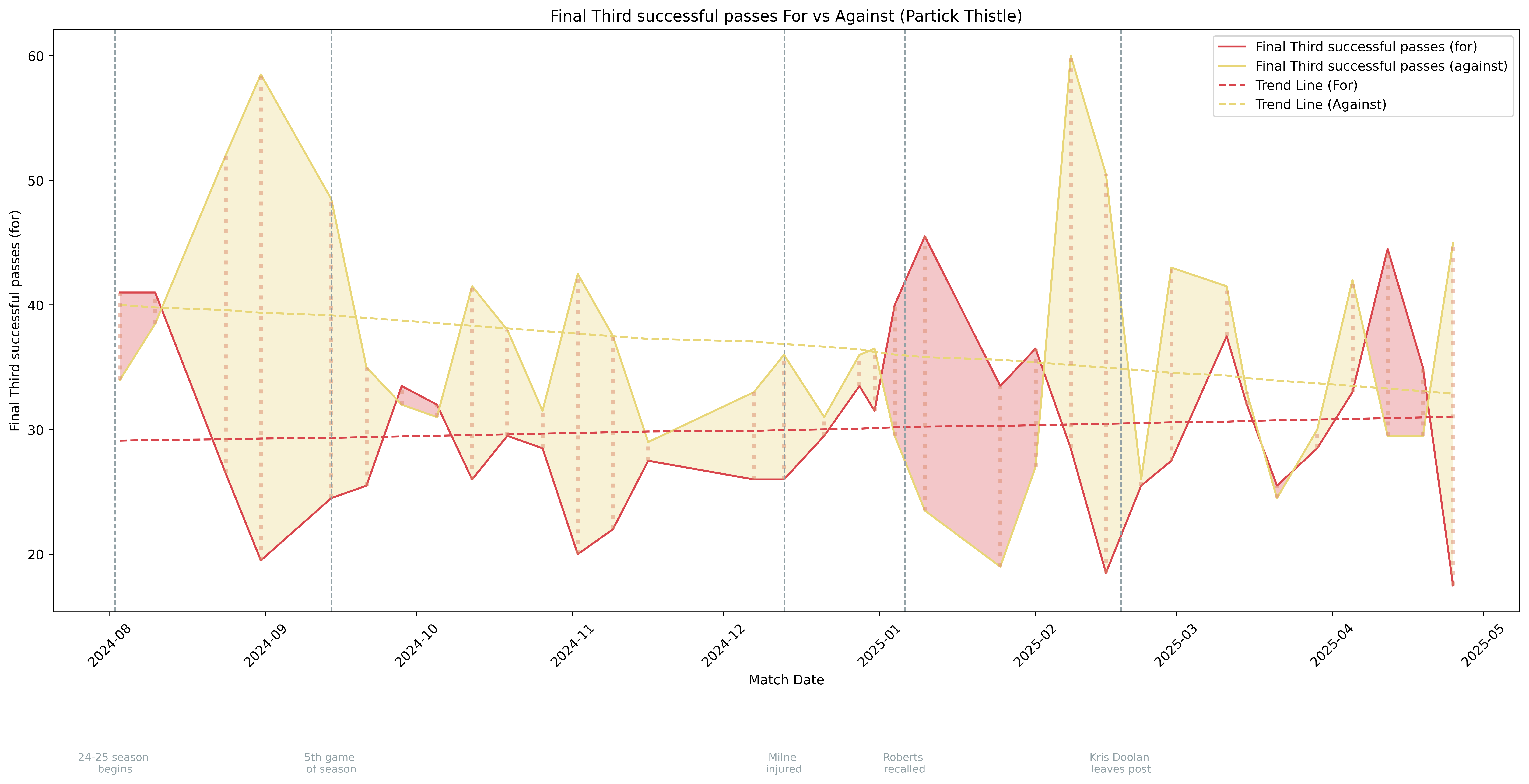
For most of the season, our opponents have successfully completed far more passes in the final third of the pitch than we have. There have only been brief spells where that has been reversed. We don’t make enough passes in that zone successfully.
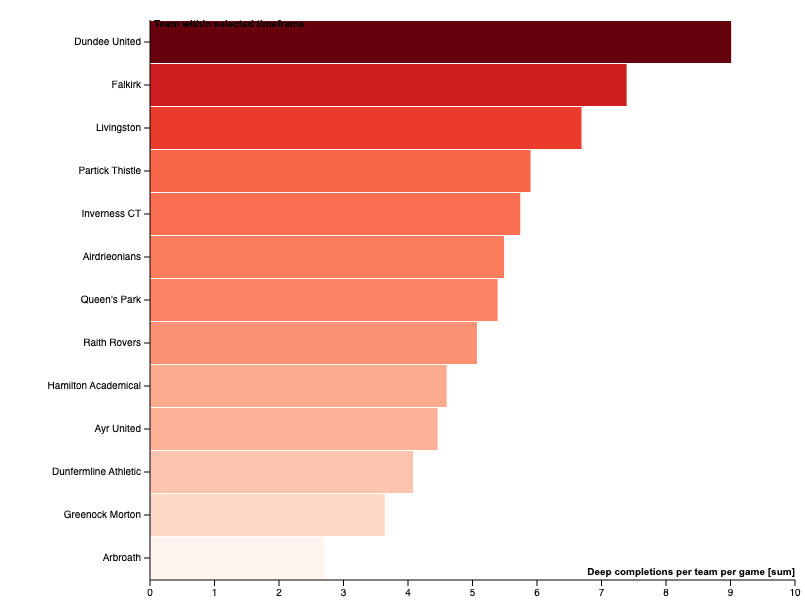
A particular flavour of these dangerous passes is the ‘deep completion’ - that’s a pass that is targeted to put the ball within 20m of the opponent’s goal (not including crosses). Again, Falkirk (7.4) and United (9.0) did more of these per game than anyone else in the league. What do deep completions make? Champions!
Livi also generate a lot of these. Ayr not so much … but only because most of their danger passes come from wide.
If you want an elite attack, you need to make this sort of pass. Thistle need to find another 2 a game on average to be comparable with Falkirk.
And once again, we’ve relied on Lawless for this pass. In the last two seasons, he has generated about 30% of our deep completions. So without him, or with him still recovering from injury, we’re closer to Hamilton and Arbroath than Falkirk and Dundee United. Only Fitzy also breaks 1 per game on average.
Getting crosses in is good (and necessary), but you also very much need to get these more central passes, putting it close to the opponent’s goal.
Passing
So we need to lift our progressive actions, and we need more deep completions.
But more generally, we need to improve our passing.
On average, in the league, teams make about 8.2 passes per minute of ball possession. Livi and Falkirk this season both made 8.7 (well above average). We make bang on the league average. So Livi and Falkirk move the ball around faster.
But they are also much more likely to generate a shot by passing. For every 100 passes Falkirk and Ayr make, they generate 2.32 ‘key passes’ (shot-creating passes). Livi generate more than 2. Thistle generate only 1.82 (the third lowest in the league this year).
The top teams move the ball at a faster tempo. And they are more likely to pass in a way that creates a shot (or at least their passes more often create shots).
Thistle are slower passers, and each pass is less likely to generate shots. You can deal with slower passing if you’re above average key pass-to-pass ratio. Or the other way around. But we’re below par on both.
Both of these need lifted next year to make an elite attack.
Possession
The fourth element is how well we retain possession. Broadly speaking, more time on the ball correlates with more points. But particularly noticeable is how often you give up the ball needlessly.
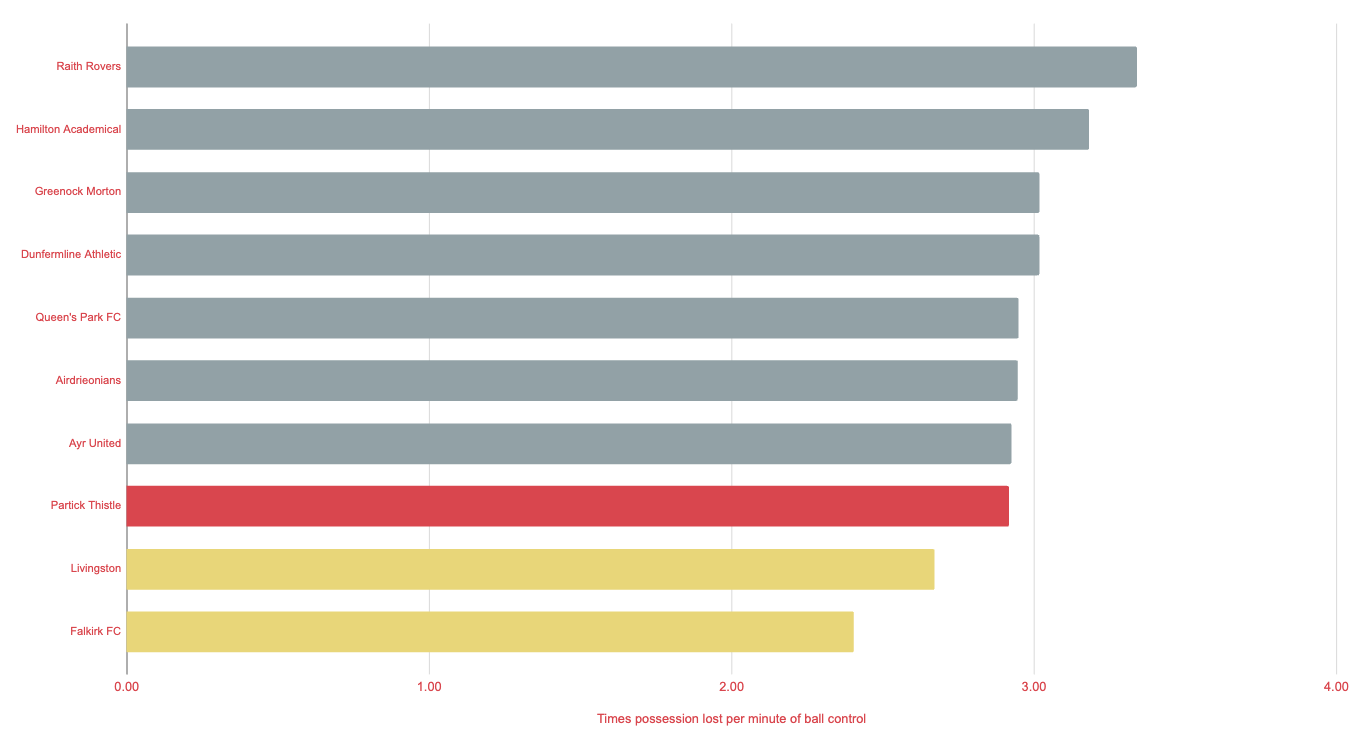
Thistle are actually quite good in this regard. But we’re a long way short of the top two. Livi lose control of the ball 8% less than Thistle, and Falkirk 18% less.
Teams that challenge for the league, and that are able to create goals, are better at holding onto the ball and not giving it away needlessly. We need at least to maintain where we’re at, but if we want to stand out from the pack, we need to reduce the needless ball losses by about 10% next year.
You can’t score if you don’t have the ball. Possession is nine-tenths of the goal.
Pressing
The penultimate ‘p’ to improve our attack is pressing. We’ve got noticeably better at this under Graham and Wilson, but there’s still work to do.
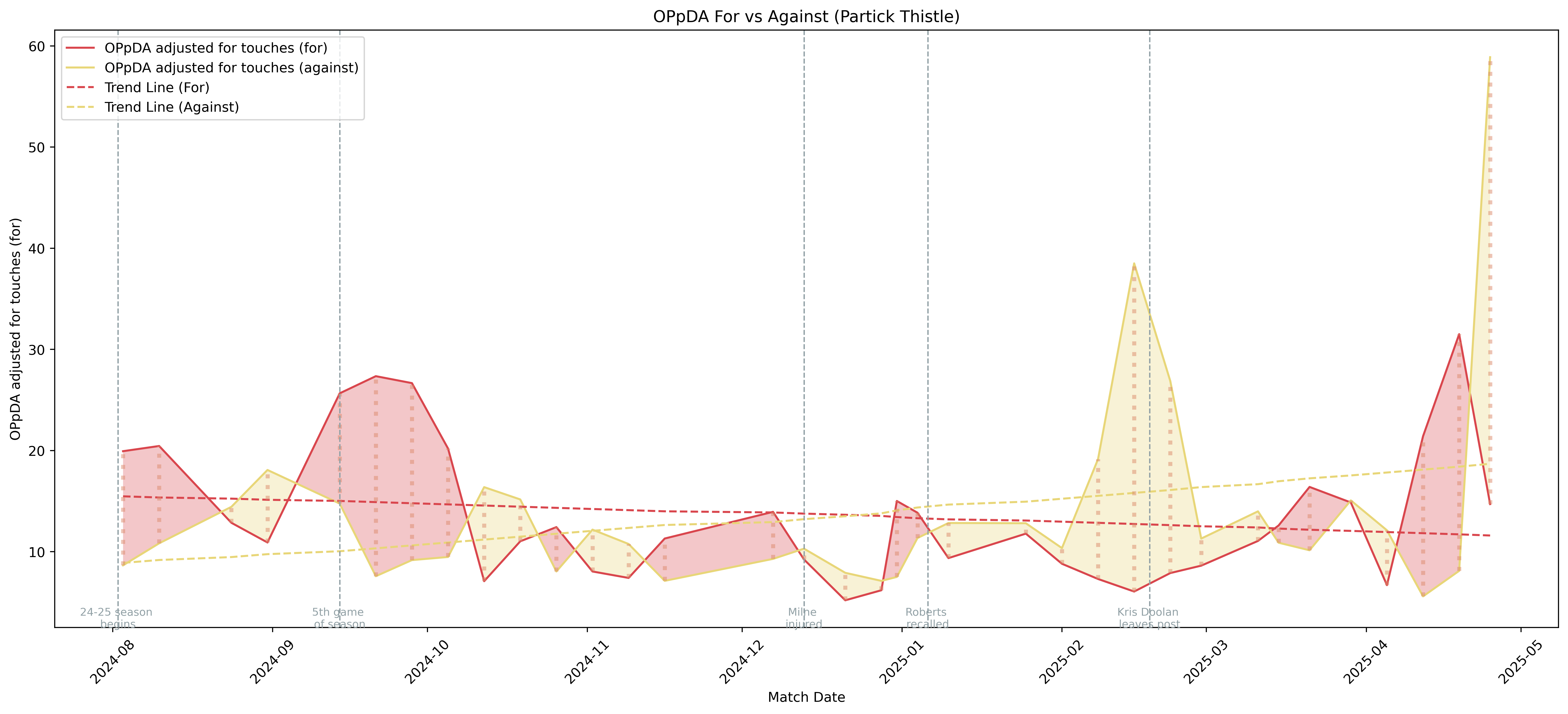
Thistle have the 4th most intense press over the course of this season. Which is good. But Livi’s is about 25% more intense than ours. And Falkirk - who tend to press only a bit away from home - about 3-5% more intense.
It’s particularly pronounced in the attacking unit, though. Thistle’s attacking unit (forwards, attacking midfielders and wingers) make 3.9 defensive actions per 100 touches, which is a lot less than Livi (4.2), and wins 15 duels per 100 touches compared to Ayr’s 16 and Livi’s 17.
Our forward line mostly doesn’t work as hard to restrict the opposition as the teams above us, and we score fewer goals as a result.
Positioning
The final point is positioning. Football is about exploiting the gaps left by opponents. Teams that are better at finding the spaces get more chances and score more goals.
The big one for me is attacking half-space usage. Imagine drawing a zone in the opponent’s half of the pitch that goes down the middle 60% of the pitch (leaving out the right and left wings). And then scrub out the penalty box, and the strip in the middle 20% of the pitch, in line with the ‘D’ at the edge of the box. You’re left with two boxes to either side of the D. Those are the attacking half-space. And traditionally, it’s one of the gaps you really, really want to exploit if you’re going to create chances.
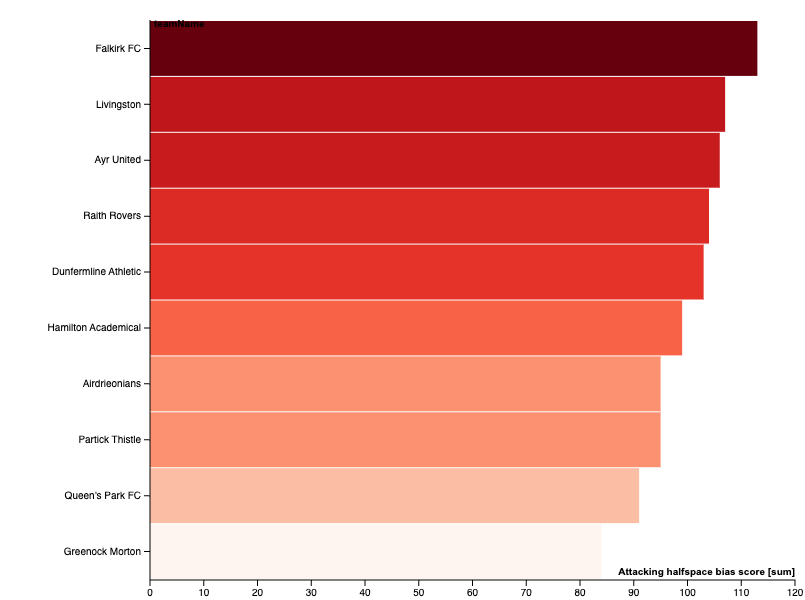
This chart shows the bias each team has for driving for that zone (basically what fraction of the team’s touches are in one of those attacking half-spaces, where you might find a gap between midfield and defence, or in a channel between defenders).
Falkirk, Livi and Ayr are all above average, and find those zones a lot. Thistle are third worst in the league.
If you classify players with at least 15 touches in the attacking half as ‘hot’ players if more than 40% of their touches are in these exploitable half-spaces, Thistle under Doolan averaged 2.14 hot players per game. Livi and Falkirk were both north of 2.7.
Under Graham and Wilson, we’ve dropped slightly to 2.10. Falkirk have pushed up to 3.10.
The big concern to me is who hits that zone. Scott Robinson hit the half-spaces in more than half his attacking touches for us. Ricco Diack hit it in 44% of his attacking touches. Neither of them have played for us in the second half of the season. The only other player above 40% in our side is Stanway, who’s been in and out of the side.
Teams who hit that zone get more goals. And we don’t have anyone who finds the half-space regularly enough.
So we need to find a player for next season who does hit that zone often enough to create space and chances.
Tonight may or may not be the last game of the season. But whatever happens, we need to lift our attacking play next season - looking at the teams who’ve succeeded recently in the division at least gives us some tangible ways to do that.