
It's time
Fifth time's a charm

Well, we’ve arrived at that time of year. The most magical time of the year, some say. Time to dust off the shorts, and appreciate the solar powered Jags.
It’s playoff time.
As is often the case, a conversation earlier in the week got me thinking
On Draw, Lose, or Draw, we discussed the last four years of playoffs and what that means going into this year. After all, we remember the incredible vibes as Thistle almost drove to the Prem back in 22-23, with McMillan, Lawless, Tiff, BBG, et al. What was the characteristic of that year, and what was better or worse in other attempts? And are we in a better or worse place this season to make a run at getting promoted?
The first thing that’s worth saying is that, of course, this season is the first time in that stretch that we haven’t had to play in the first round - which has several benefits (the players are more rested, there’s more time to prepare and research, training is more controlled, and we get home advantage in the second leg, to name a few).
But what else can we factor into the start of this playoff campaign?
I’ve picked out a few areas that are worth paying attention to. In each case, I want to review a few things:
How has our ‘regular season’ pattern been and is it more similar to 22-23 (big vibes), or to 21-22 (too much too soon), 23-24 (worse than 22-23 but still pretty good), or last season (a step too far with a jaded, battered squad)?
What changed in each of the previous seasons between the regular season, and the resulting playoff run? This might give us a clue what we need to do to get over the line this time
Overall game balance
First, let’s look at our overall game. In each of the following charts, the yellow dot shows the ‘regular season’ and the red dot the playoff games1.
Area: expected goal difference. In other words, add up all the xG we generated and take away all the xG we conceded, and divide by the number of games played. xGD of +1.0 means that in an average game, we generated around 1 more xG in attack than we condeded to opponents. Over a season, this is a good indication whether the team should be winning games.
Regular season patterns
In 22-23, we had an incredibly strong positive xGD even before the playoffs - between +0.7 and +0.8.
23-24 was still cautiously positive, 21-22 less so, and 24-25, we were basically break-even
This season, we’re doing pretty well - the second most impressive xGD since we returned to the Champ. It’s not as high as the vibes season, so we’re starting from further back. The big issue has been the last couple of months, where we’ve allowed opponents to generate more chances against us.
Playoff trends
In almost every previous year, we’ve gone up in the playoffs - generated a better xGD than in the regular season.
In 21-22 and 23-24, it climbed almost to the level of the regular season in 22-23.
Last year, with a more limp performance in the playoffs, though, we dropped off from a low start point to a negative xGD
So what?
We’re starting from a good base, especially if we can improve our defensive numbers to where they were earlier in the season
In order to get to our more successful levels, we need to lift this even more - more xG generated, less xG conceded. Ideally, we need that number to swing by at least +0.5
Area: Possession - this is pretty straightforward.
Regular season patterns
We have the highest average possession of any season in the last five - only 22-23 was even close
For the last two seasons before this, we have had under 50% of the ball - that has been decisively reversed this year
Playoff trends
In pretty much every season, we end up with less possession in the playoffs. This is sort of expected - you’re playing against the stronger teams in your own league, plus a well-financed team from the league above if you get to the final, so it’s harder to dominate than it is agains the weaker teams in the Champ
Normally, the drop-off is between 3 and 4 percentage points.
In 22-23, this kept us just below 50% - this year, it would keep us just above
So what?
The big thing that’s different this year is that we are set up to dominate the ball - to impose our gameplan on opponents. We can expect not to be quite as dominant, but that changes the feel of the matches
More time on the ball is better for stamina - you don’t have to press intensely, you don’t have to focus on slimmer pickings going forwards.
It’s encouraging though that we go into the playoffs with a much more similar profile to 22-23, and we’re likely to have a smaller drop-off because we only have to play semi-finals and (hopefully) finals, and not the QF.
Attacking
Area: Shot volume - basically how many shots on target we generated per game
Regular season patterns
in 22-23 and 23-24 (the two seasons we were more competitive), we started with aa higher baseline - over 4 shots on target per game
In 22-23, that was almost 5.5 per game
This is related to the xGD, but is also a way of saying not just that we get chances, but that we actually force the opponents to do something about it - to block or save shots
Last season, the rate of shots on target was much, much lower - only 3.5 per game. That is a measure of the fact that our attack had become collapsed down to ‘can BBG get a shot?’ by that stage.
This year, we’re starting from a baseline between 23-24 and 22-23 - north of 4.5 per game
Playoff trends
This as an interesting difference to what we’ve seen so far. In the ‘good’ runs, we lifted our attack noticeably - at least 1 or 2 more shots on target per game
Interestingly, 22-23 wasn’t quite as much as a lift - in 23-24, we lifted the shots on target volume to higher than the previous year (the Blair Alston effect, obviously)
In the less compelling seasons (21-22 and 24-25), the shots on target rate dropped off noticeably
So what?
We’re starting from a good place - with an attack that generates a lot of chances, and forwards who turn those chances into shots on target
If we want to make a run, we’ll have to lift that further, probably adding at least one or two more shots on target per game than our regular season average.
Area: Deep completed passes per 90. These are passes that put the ball to within 20m of the opposition goal. They are a dangerous sort of pass that creates chances for team-mates in the higher-percentage zone. Normally, a dangerous attack excels in at least two of three creative styles - crossing (think Harry Milne), running (think Scott Tiffoney) with the ball, or passing into dangerous areas for players to run onto. Thistle have been at their best when they generate a lot of these deep completed passes - they might be through balls, cut-backs across the face of goal, or other passes, so long as they end up within 20m.
Regular season patterns
22-23 is the only season we’ve averagedmore than 7.5 deep completed passes per game - this is the sort of pass that Stevie Lawless excelled at
In every other previous season, we were 7ish or lower, and as low as 6 last year (this was one of those areas where we had to recruit in players and train tactics that maximised because we fell away massively last season, and it damaged our attack)
This season, though, we’re starting from our highest baseline in five years - almost 9 deep completed passes per 90
Playoff trends
It’s generally harder to make this sort of pass against more structured or tenacious defences - for instance, a well rested unit who’ve skipped the first round, or an intense presser like Livi last year, or a very deep defensive line like Dunfermline have reverted to recently
In three of the previous seasons, the playoff rate stayed quite close to the regular season
But in 22-23 - the big season - we catapaulted this number up hugely, from around 7.75 to 10 per game. That’s huge, and it was the reason our attack was so fun to watch. Again and again that year, we were putting balls deep into danger
So what?
We’re starting from the best structural attack in five years. We’re not at vibes playoff levels, but we’re not far off it. It wouldn’t take much to rachet it up
We probably need someone like Turner, Taylor, or one of the attacking 8s (like Stanway) to clock in a few more of these. But we’re structurally set up to do it in a way that we haven’t been since 22-23
This is the single most correlated factor that we could easily replicate this year
Area: Getting the ball into the penalty area. There are two other ways to get the ball into ‘having a chance at a shot’ territory - running it in, or crossing it in.
Regular season patterns
The more successful seasons had around 4-5 runs into the penalty box per game in the regular season
We’re at about that level this year (a touch lower than 22-23, but still in that zone)
Crossing is more volatile, but we are currently at the highest volume of crosses to the penalty area per 90 of the last five seasons
Playoff trends
In 22-23, the big difference to the other years is that we ran the ball into the box more in the playoffs than we did the rest of the season (think Tiff, McMillan, et al bombing into the box)
In all the other seasons, we’ve dropped off our running attack - sometimes by as much as 3 runs a game
Cross volume also tends to drop a bit - in 23-24, we crossed in more in the playoffs than the rest of the season, but in 22-23, we effectively traded crosses for more runs. With the team we had that year, that made sense, as we had multiple players who could wreak havoc this way.
So what?
We have the best crossing team we’ve had in years, and our running box entries are around as good as peak playoff seasons
The way we succeeded in 22-23 was to cross a bit less and run a lot more in the playoffs - probably because it’s a way to unsettle teams that are tiring, and keep them unsettled. Chaos is good!
That’s not to say that we need to do that same thing this year, but this year, we don’t have BBG to lurk in the penalty box to get on the end of crosses, so getting the likes of Stanway, Watt, Fitzy, Chalmers, McPherson, and co running at teams seems like a good way to replicate this form
Out of possession
The other side of the ball matters too - especially as you end up facing better equipped Prem teams, or teams with potent running and shooting threats.
Across several metrics, there are fewer clear patterns out of possession, though.
We tend not to change as much between the regular season an playoffs, and there are fewer patterns in terms of the regular season itself.
We are winning a higher fraction of contested balls than in any previous season this year
We are making far fewer sliding tackles (no Banzo, no Milne)
We are recovering the ball more often in the opponent’s third, close to their goal much more
We are pressing more intensely than any season since 21-22
In most previous seasons, the out of possession numbers stayed quite consistent, other than 23-24, when we shifted to being more aggressive, winning more duels, recovering the ball more, making more tackles, and so on
Basically: at first glance, the most important thing to lift is our attacking output rather than our defensive numbers. It’s crucial to maintain our best defensive play, but it’s more important to find another gear going forward if we want to make a run at the playoffs like 22-23.
So what are our chances?
Given all of that, and where we’re starting from, what are Thistle’s chances?
I ran some numbers last year to simulate the playoffs, so I thought I’d give that another bash. I’ve tweaked the model to take more into account this time (I’m sure you don’t care about the detail). But let’s play out some scenarios and see where we might end up.
It’s worth saying that there are a lot of unknowns at this point - who’ll win the QF tonight, which Prem team will finish in 11th, and so on. So the model does this:
Takes into account the actual results so far (i.e. the first leg of the QF last Tuesday)
Simulates the remaining QF game based on the relative strengths of the two teams, and the home advantage, and recent form and attacking output
If the simulation ends up level, play some extra time, and if it’s still level after that, simulate penalties (with a slight home advantage)
Simulate the Semi-Final in the same way (based on who one the QF)
Simulate the remaining games in the Prem to find which team faces the winner of the SF. This takes into account current standings
Simluate the final in the same way as the QF and SF
Repeat this many, many times (100,000 to be exact)
When you do that, Thistle win the playoffs around 38% of the time, and 67% of the finals we get to. Killie win another 31% of the sims, Dunfermline 22%, and so on.
Basically, at this stage, we win more than anyone else does, but that’s partly because we face one of three different Prem teams, so each of the Prem teams get fewer chances win (which they’re presumably happy with!). Dunfermline have almost the same win rate as us when they reach the final. I expect as the picture becomes clearer after tonight, and as the Prem settles to a fixed team in 11th, we’ll drop our win rate a bit.
But at this stage, I’m pretty happy with that.
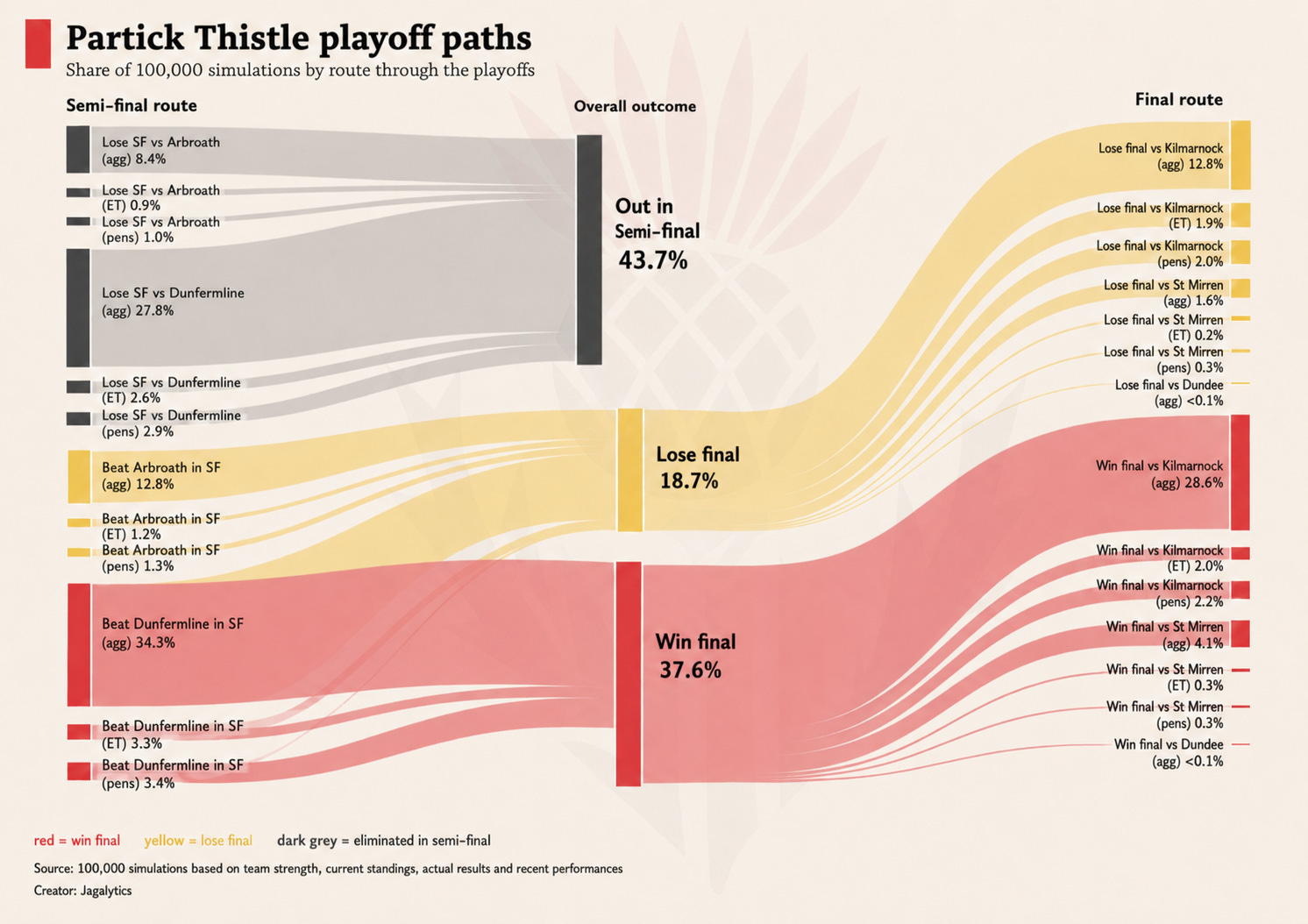
I’ve broken down all of the scenarios in this last chart. We go out in the semi-final 44% of the time - in other words, we’re favourites even at this point to get to the final, but not overwhelmingly so. I’d like to think we’d be stronger favourites if we were the early season Jags, which we could still get back to, but I’d be cautious about declaring us sure and certain winners against tonight’s victors.
Our most likely route through is to beat Dunfermline and then Killie, both on aggregate (about 21% of sims). The only other scenario that happens in double digit percentages is losing to the Pars in the semis (27%). After that, we’re down to rarer combos (beating Pars, losing to Killie, both on aggregate - 9%, for instance).
At this point, it seems like the most likely path is that we’ll have to beat Dunfermline and Killie (which I wouldn’t mind, as it means we don’t have to drop Taylor and Smyth as we would against St. Mirren, or Ethan “The Major” Ingram as we would against Dundee).
It’s still a tough ask to get promoted this way. But Thistle are in the best position they’ve been in years. I can already feel the poisonous sting of hope seeping into my veins.
It’s time.
There’s a bit of a health warning here - the playoff data is a small sample, so you should be cautious in reading too much into the actual numbers. For instance, in 21-22, there are only two games considered.